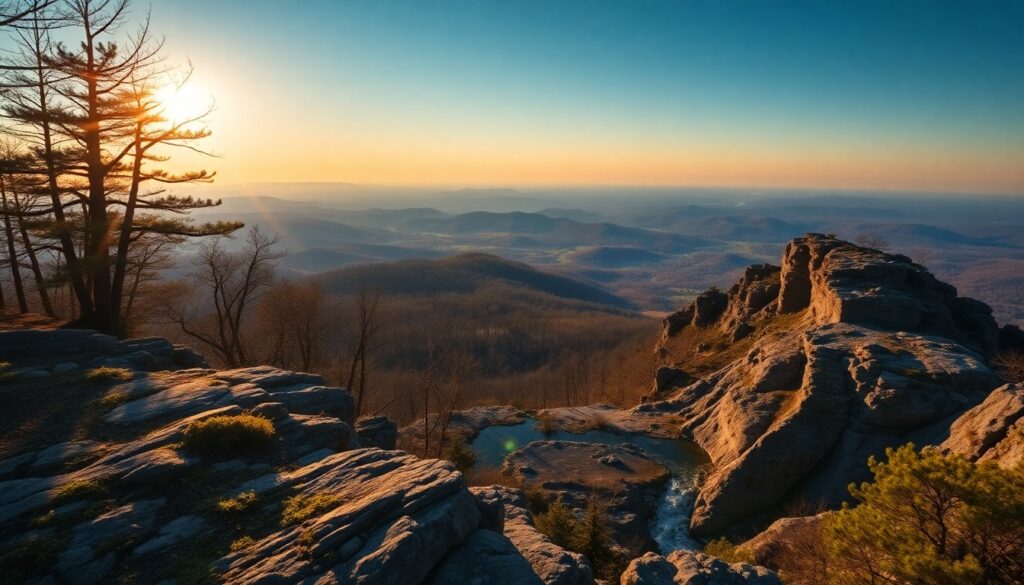
From the rocky precipice of **Hawk Mountain Lookout**, a sweeping panorama of forested ridges and the distant Lehigh Valley unfolds beneath a vast, open sky. The crisp autumn air, often carrying the scent of fallen leaves and distant pine, is frequently punctuated by the silent, majestic glide of a broad-winged hawk or the sharp cry of a kestrel as it rides the thermals. Standing here, you are not merely observing nature; you are immersed in one of the world’s most spectacular raptor migration corridors, a truly unparalleled experience that draws visitors from across the globe to this iconic Pennsylvania landmark.
Trail Specifications
Trail Name: Hawk Mountain Lookout Trail (often combined with North/South Lookout trails)
Location: Kempton, PA (Hawk Mountain Sanctuary)
Distance: Approximately 2.5 – 3.0 miles (loop incorporating North & South Lookouts)
Elevation Gain: Approximately 350 – 450 feet
Difficulty: Moderate
GPS Coordinates (Visitor Center): 40.6360° N, 75.9897° W
Best Season: Autumn (September – November) for raptor migration; pleasant year-round
Dog-Friendly: No (Dogs are NOT permitted on the trails)
Route Overview & Natural Highlights
Your journey to the Hawk Mountain Lookout traverses a section of the Kittatinny Ridge, a prominent geological feature of the Appalachian Mountains. The terrain is characteristic of the Pennsylvania Highlands, dominated by mixed oak-hickory forests. As you ascend, you’ll navigate a path that ranges from well-graded dirt to rocky sections, often strewn with the unmistakable quartzite and sandstone scree that defines this ancient ridge. Keep an eye out for towering red oaks (Quercus rubra), various hickory species (Carya), and the occasional eastern white pine (Pinus strobus) creating a dense, verdant canopy in warmer months.
The sanctuary’s unique position on the Kittatinny Ridge makes it a bottleneck for migrating raptors. From mid-August through December, tens of thousands of broad-winged hawks, sharp-shinned hawks, red-tailed hawks, and even golden and bald eagles funnel along this aerial highway. Beyond the avian spectacle, the forest floor teems with life; you might spot white-tailed deer, listen for the drumming of a ruffed grouse, or in quieter moments, glimpse a black bear. Geological marvels include the “River of Rocks,” a massive, ancient talus slope formed by frost wedging, composed of countless quartzite boulders, offering a stark contrast to the surrounding forest.
Turn-by-Turn Trail Breakdown
Trailhead to Initial Ascent: Your adventure begins at the Hawk Mountain Sanctuary Visitor Center. After checking in, you’ll start on the main Lookout Trail, a wide, well-maintained path. The initial segment is a gentle but steady climb through a mature forest. Interpretive signs along the way offer insights into the sanctuary’s history, founded by Rosalie Edge, and the local ecology. You’ll quickly feel the elevation gain as the trail winds upwards, preparing you for the views to come.
Mid-Trail Features & Approach to Lookouts: As you continue, the trail narrows in sections and becomes rockier, demanding sturdy footwear. You’ll pass several smaller, unnamed overlooks that provide tantalizing glimpses of the landscape. If you’re opting for a loop that includes the North and South Lookouts, you’ll navigate clearly marked junctions. The path to the North Lookout, in particular, becomes quite rugged in its final approach, involving some rock scrambling. Here, you’ll notice the distinct change in flora as the wind-swept exposure encourages more resilient plant life like mountain laurel (Kalmia latifolia) and various ferns.
Summit/Destination (Hawk Mountain Lookout) & Return: Reaching the North Lookout is an exhilarating experience. Stepping onto the exposed rock ledges, you are immediately greeted by a breathtaking, unobstructed view of the Appalachian ridges stretching into the horizon and the verdant valleys below. This is where the raptor migration spectacle truly comes alive; naturalists are often on hand during peak season to identify species soaring overhead. After soaking in the views and observing the aerial ballet, you can either retrace your steps for an out-and-back journey or continue on a loop, perhaps via the South Lookout (offering equally stunning, though slightly different, perspectives) and then back down towards the visitor center, completing a fulfilling circuit through this unique ecosystem.
Seasonal Guide & Best Times
- Spring (March – May): Witness the awakening forest with budding trees and early wildflowers. Migratory songbirds return, filling the air with their calls. Cooler temperatures make for comfortable hiking, though raptor sightings are less frequent than in autumn.
- Summer (June – August): Enjoy the lush, dense canopy offering shade and a cooler escape from the summer heat. While raptor migration is minimal, the vibrant green landscape and diverse plant life are captivating. Be prepared for higher humidity and potential thunderstorms.
- Autumn (September – November): This is the absolute peak season for Hawk Mountain. The combination of brilliant fall foliage and the spectacular raptor migration creates an unforgettable experience. Expect larger crowds, especially on weekends in October. Arrive early for parking and optimal viewing.
- Winter (December – February): Experience the solitude and stark beauty of the mountain under a blanket of snow. The bare trees offer expansive views, and while fewer raptors are seen, hardy winter residents and occasional golden eagles pass through. Trails can be icy, requiring extra caution.
Essential Gear & Safety
- Sturdy Hiking Boots: The rocky and uneven terrain, especially near the lookouts, necessitates good ankle support and traction.
- Water and Snacks: Carry ample hydration, particularly on warmer days, and energy-boosting snacks for your hike.
Curated Literature & Philadelphia Downtown Calendar
The Architecture of Focus: Deep Work & Modern Mastery
By Founders Library Press
A structured framework for strategic clarity, productivity, and authentic execution.
Upcoming Downtown Happenings
Live acoustic sessions, gallery receptions, literary salons, and independent trade shows across Philadelphia.